
Voices for a Better Japan: Insights from Anthropology, Religion, Sociology, and History

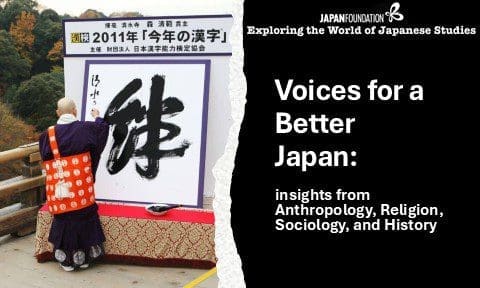
Image: A monk painting the Kanji of the Year 2011, ‘kizuna’, meaning bonds, chosen following the 2011 Tohoku triple disaster. Credit: https://www.jiji.com/jc/d4?p=knj120-jpp11868337&d=d4_dd
Date: Wednesday 11 March, 2026, 6pm – 7.30pm
Venue: Lecture Room 6.213, University Place Room, The University of Manchester
This event will also be livestreamed via Zoom.
Are you someone with a general interest in Japanese culture and society? Or are you a sixth form student or current university student, either studying Japanese language or with an interest in learning more about Japan? Why not come and listen to our next lecture as part of our seminar series: ‘Exploring the World of Japanese Studies‘!
Our fourth talk, Voices for a Better Japan: Insights from Anthropology, Religion, Sociology and History, is supported by the University of Manchester. We will be joined by Dr. Chika Watanabe, Prof. Erica Baffelli, Dr. Yuki Asahina and Dr. Aya Homei, with a special introduction to Japanese Studies at the University of Manchester by Dr. Peter Cave.
Talk Description
On March 11, 2011, at 2:46 p.m., a 9.1magnitude earthquake struck off the northeast coast of Japan, triggering a devastating tsunami and a nuclear meltdown at the Fukushima Daiichi nuclear plant. Marking the fifteenth anniversary of the Great East Japan Earthquake, this event will explore what happens when disasters and crises occur and how individuals and communities respond to them. Each speaker will give a short presentation (approximately 10 minutes) drawing on their specific area of expertise, followed by questions from the audience.
The presentations will explore themes such as the intersections between disaster preparedness and art in activities with children; new social connections created through disaster relief activities in Tohoku with marginalised communities in Tokyo; collaboration between labour unions in supporting temporary and precarious workers; and actions, including formal apologies, addressing Japan’s painful past of forced sterilisation. Collectively these talks will reflect on examples from Japan that show how individuals and organisations mobilise to respond to disasters, crises, and difficult historical legacies.
About the Speakers:
 |
Dr. Chika Watanabe Chika WATANABE is Senior Lecturer in Social Anthropology at the University of Manchester. Her research and teaching focus on disaster preparedness, play, futurity, and humanitarian and development aid. She has two forthcoming books, Play to Survive: Disaster Preparedness Along the Ring of Fire (2026) and Patchwork Ethnography: a Methodological Guide (2027). |
 |
Professor Erica Baffelli Erica BAFFELLI is Professor of Japanese Studies at The University of Manchester (UK). She is interested in religion in contemporary Japan, with a focus on groups founded from the 1970s onwards. Her research projects and publication focus on religion in contemporary Japan; religion and media; new and minority religions; religion, gender and violence; and Buddhism and emotion. She is currently PI on a Leverhulme Research Project on “Fear and Belonging in Minority Buddhist Communities” (2023-2027). |
 |
Dr. Yuki Asahina Yuki ASAHINA is a lecturer in Japanese Studies at the University of Manchester. Trained as a sociologist, his research interests include social inequality and political sociology, focusing on Japan and South Korea. Yuki has recently completed his first book manuscript, Meritocracy’s Children (2027), and an edited volume, The Digital Rise of the Far Right in Japan (2026). |
 |
Dr. Aya Homei Aya HOMEI is a Reader in Japanese Studies at the University of Manchester. Her research focuses on the history of medicine and science in modern Japan and East Asia, with interests in reproduction, population, gender and diplomacy. Aya is the author of Science for Governing Japan’s Population (2023) and co-edited Medical Women in the Japanese Empire (2025). Most recently, she is working on a historical book examining Japanese family planning and healthcare diplomacy in Southeast Asia and involuntary sterilisation in Japan after World War II. |
 |
Dr. Peter Cave : Introduction to Japanese Studies at Manchester Peter CAVE is Senior Lecturer in Japanese Studies and director of the Japanese Studies programme at the University of Manchester. His research focuses on education in Japan, both contemporary and twentieth-century. His publications include books on primary and junior high school in Japan, as well as articles about educational reform, history education, maths education, and club activities in Japanese schools. |
This event is free to attend but registration is essential
Contact Information
For enquiries about this event, please contact:
Japanese Studies & International Dialogue
LO_JapaneseStudies@jpf.go.jp
General Enquiries
LO_info@jpf.go.jp
Phone: +44 (0)20 7436 6695