
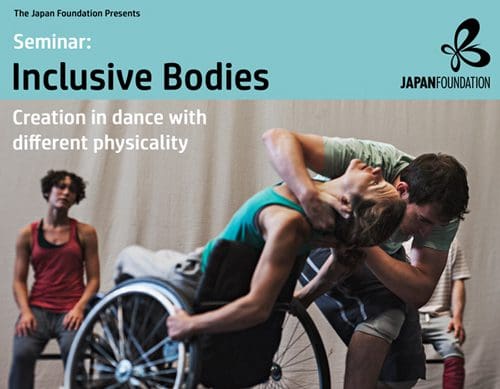
Inclusive Bodies – Creation in dance with different physicality

Arts & Culture
  • 11 June 2018
  • 19:00–00:00
  • Sunley Pavilion, Royal Festival Hall, Southbank Centre, Belvedere Road, London, SE1 8XX  Photo Credit: Chris Parkes The research project between Stopgap Dance Company and the Japanese artists, Yukio Suzuki and Kenta Kambara is supported by the Japan Foundation through the Performing Arts Japan for Europe grant programme. This event is free to attend but booking is essential (places are limited). To book your place via Eventbrite, please click here. If you have any accessibility requirements please let us know when booking by contacting info@jpf.org.uk. Unfortunately we are unable to provide sign language interpreting.
Organised

According to the European Youth Portal ‘Dance is a universal human activity’. In spite of this all-encompassing notion, it is only in recent years that all body types have been given access to similar levels of training for performance (although these opportunities are still not widespread). While words such as ‘diversity’ and ‘inclusivity’ have been the key to opening the doors of performing arts in the 21st century, there are still questions as to how these buzz words are applied in the creative process to all physicality – disabled and non-disabled, Asian and European, in order to both embrace and celebrate their differences.

According to the European Youth Portal ‘Dance is a universal human activity’. In spite of this all-encompassing notion, it is only in recent years that all body types have been given access to similar levels of training for performance (although these opportunities are still not widespread). While words such as ‘diversity’ and ‘inclusivity’ have been the key to opening the doors of performing arts in the 21st century, there are still questions as to how these buzz words are applied in the creative process to all physicality – disabled and non-disabled, Asian and European, in order to both embrace and celebrate their differences.
In this special seminar, the Japan Foundation has invited Stopgap Dance Company, a UK-based company of disabled and non-disabled dancers, to deliver a short presentation of research undertaken with internationally acclaimed Japanese choreographer and dancer, Yukio Suzuki, and Japanese disabled dancer, Kenta Kambara. The research sought a way for the disabled and non-disabled dancers involved (from Europe, UK and Japan) to use their bodies to portray what is in their minds during their performances, exploring similarities of approach between Stopgap’s inclusive creative processes and that of Butoh. Joined by UK-based choreographer Adam Benjamin, they will explore in discussion the way they understand physical and cultural differences, and how these differences contribute to creativity in dance making. 

In this special seminar, the Japan Foundation has invited Stopgap Dance Company, a UK-based company of disabled and non-disabled dancers, to deliver a short presentation of research undertaken with internationally acclaimed Japanese choreographer and dancer, Yukio Suzuki, and Japanese disabled dancer, Kenta Kambara. The research sought a way for the disabled and non-disabled dancers involved (from Europe, UK and Japan) to use their bodies to portray what is in their minds during their performances, exploring similarities of approach between Stopgap’s inclusive creative processes and that of Butoh. Joined by UK-based choreographer Adam Benjamin, they will explore in discussion the way they understand physical and cultural differences, and how these differences contribute to creativity in dance making. 

Contact Information

For enquiries about this event, please contact:

Arts and Culture Department
LO_event@jpf.go.jp

General Enquiries
LO_info@jpf.go.jp

Phone: +44 (0)20 7492 6570

Back to top